
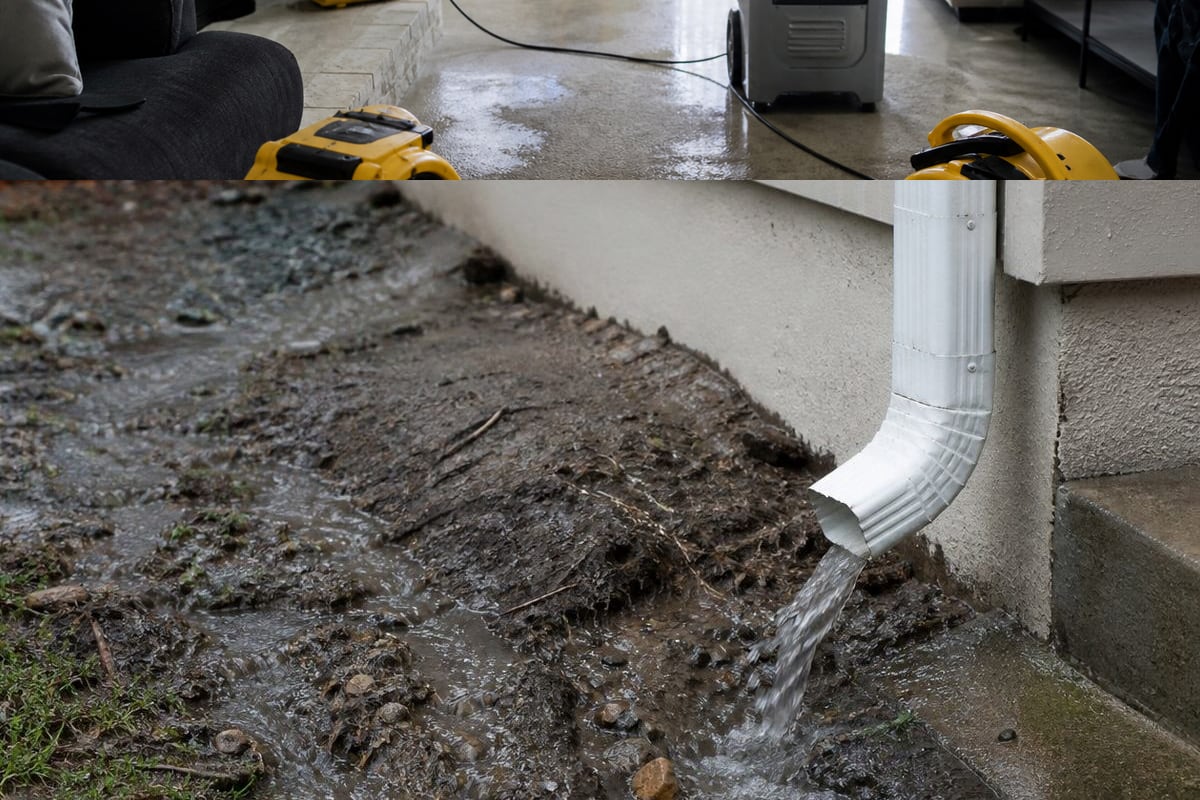
Gutters, downspouts, and grading rarely get credit when they're doing their job. Nobody notices well-maintained drainage. They only notice the wet stain creeping up a foundation wall after the first real storm of the season, by which point the fix is a lot more involved than a Saturday afternoon of gutter cleaning would have been.
This guide treats gutters, downspouts, and grading as the single connected system they actually are, since fixing one piece while ignoring the others usually just moves the water problem somewhere else on the property.
How Gutters, Downspouts, and Grading Work Together to Prevent Water Damage
Gutters, downspouts, and grading work together as a single water management chain, where gutters collect roof runoff, downspouts carry it away from the structure, and grading, meaning the slope of the ground around your property, directs it further away instead of letting it pool against the foundation. A weak link anywhere in that chain sends water toward the one place you don't want it, which is against or under your walls. Fixing gutters without checking grading, or the reverse, is one of the most common half-measures property owners take, and this guide is built around addressing the whole system at once, the same way California Storm Preparation Checklist for Property Owners (2026 Winter Rain Season Guide) approaches whole-property storm readiness.
How Often to Clean and Inspect Your Gutters and Downspouts
Clean and inspect gutters at least twice a year, with the most important cleaning happening right before Southern California's rainy season begins, since gutters that sat dry and untouched all summer are the ones most likely to overflow during the first major storm.
Why Southern California's Dry Season Creates a Hidden Risk
Southern California's long dry season creates a hidden risk because gutters can go six months or more without any rain to reveal a clog, meaning debris quietly builds up while nothing forces the issue. The first atmospheric river storm of the season then hits a system nobody has checked since spring, which is exactly the wrong time to discover a blockage.
Pre-Rainy-Season Inspection Checklist
- Clear all leaves, debris, and roofing granules from gutters
- Flush downspouts to confirm free flow
- Check gutter brackets and hangers for sagging or looseness
- Confirm downspout extensions are attached and pointed away from the foundation
- Walk the property after a light rain to check for any pooling
Signs Your Gutter or Grading System Is Failing
A failing gutter or grading system usually shows itself through water stains near the foundation, gutters overflowing during moderate rather than only heavy rain, or visible pooling near the structure after a storm, and any of these signs warrants attention before the next major rain event.
Water Stains Near the Foundation
Discoloration, streaking, or a white mineral crust called efflorescence on foundation walls is a sign that water has been sitting against the structure rather than draining away from it.
Overflowing or Sagging Gutters
Gutters that overflow during a moderate storm, rather than only the heaviest ones, are usually clogged, improperly pitched, or undersized for the roof area they're draining. Visibly sagging sections indicate the brackets or hangers need attention before they fail completely.
Pooling Water Near the Structure
Standing water within a few feet of the foundation after rain, especially water that takes more than a day to fully drain, points to a grading problem rather than a gutter problem, since the ground itself isn't directing water away properly.
Downspout Extensions and Where They Should Discharge
Downspouts should discharge water at least several feet away from the foundation, either through an above-ground extension or an underground pipe that daylights, meaning it exits at ground level, well clear of the structure. A downspout that dumps water directly at the foundation is one of the most common and easily preventable causes of basement or crawl space water intrusion.
Above-Ground Extensions
Simple above-ground extensions are inexpensive and effective, directing water several feet from the foundation across the surface of the yard. They're easy to install but can be visually intrusive and are sometimes removed by homeowners for appearance, which quietly undoes the protection they provide.
Underground and Buried Downspout Drainage
Underground drainage routes water through a buried pipe to a discharge point well away from the house, offering a cleaner look without sacrificing function, as long as the buried line is installed with adequate slope and doesn't clog internally where it's harder to inspect.
Proper Grading and Slope Around Your Property
Proper grading directs water away from the foundation using a gentle, consistent slope, with a commonly recommended standard of roughly a 6-inch drop over the first 10 feet away from the structure, though exact requirements vary by soil type and local code.
Recommended Slope Away From the Foundation
If water pools near your foundation after a normal rain, the grading likely needs correction. This is worth checking on all sides of the property, not just the front, since a single low spot anywhere around the perimeter can direct water toward the structure.
Fixing Poor Grading
Correcting grading usually involves adding and compacting soil to reestablish proper slope, and in some cases installing a French drain, which is a gravel-filled trench with a perforated pipe that redirects subsurface water. This is typically a job for a qualified contractor rather than a DIY weekend project, since improper regrading can make drainage worse instead of better.
Gutter Guards: Are They Worth It?
Gutter guards can meaningfully reduce debris buildup and cleaning frequency, but they don't eliminate the need for periodic inspection, since fine debris, roofing granules, and small seeds can still accumulate over time even with a guard installed.
| Guard Type | Debris Handled | Maintenance Reduction | Cost Tier |
|---|---|---|---|
| Mesh screens | Leaves and larger debris | Moderate | Lower |
| Reverse-curve guards | Leaves and most debris | High | Higher |
| Foam inserts | Leaves and debris | Low to moderate | Lower |
| Micro-mesh guards | Fine debris and granules | High | Highest |
Types of Gutter Guards and Trade-Offs
Mesh and foam options are less expensive but require more frequent checking, while reverse-curve and micro-mesh guards cost more but handle finer debris more effectively. None of them are a substitute for occasional inspection, and installing guards without also correcting poor grading still leaves the foundation exposed to whatever water does make it through.
DIY vs. Professional Gutter and Grading Maintenance
Single-story gutter cleaning is a reasonable DIY task for most homeowners with proper ladder safety, while multi-story properties, steep rooflines, grading correction, and drainage installation are better suited to a professional given the fall risk and technical judgment involved.
Ladder and Roof Safety Precautions
Never clean gutters from a ladder on wet or uneven ground, and avoid working near overhead power lines under any circumstances. If your property has a steep roofline, multiple stories, or gutters positioned near power lines, hiring a professional is the safer choice, not an unnecessary expense.
How Much Does Gutter and Grading Maintenance or Repair Cost?
Costs for gutter cleaning, guard installation, and grading correction vary based on property size, roof complexity, and how much correction the grading needs. [details pending verification]
[details pending verification] Ranges
Because pricing depends heavily on property specifics, [details pending verification] Contact LA Water Damage at request a callback for a property-specific assessment.
What to Do If Poor Drainage Has Already Caused Water Intrusion
If poor drainage has already led to water in a basement, crawl space, or foundation area, prioritize safety, document the damage, and remove standing water as soon as it's safe to do so, since sitting water creates conditions for mold growth within a day or two. If the affected area has or should have a sump pump as part of its drainage design, Sump Pump Maintenance and Failure Signs Every Property Owner Should Know explains how that system works as an additional layer of protection.
When to Call LA Water Damage for Foundation or Basement Water Extraction
Call a water extraction professional as soon as the area is safe to enter, since foundation and basement water intrusion often affects materials that are slow to dry and prone to mold if left too long. [details pending verification]
Gutter and Grading Maintenance for Greater Los Angeles Properties
Greater Los Angeles properties face a specific version of this maintenance challenge shaped by the region's long dry-to-wet season transition and its mix of older and hillside housing stock. The months of dry weather common across Southern California mean drainage problems can go completely unnoticed until an atmospheric river storm arrives, often catching property owners off guard on the very first significant rain of the season. Older LA homes, particularly those built before modern grading standards, are also more likely to have grading that was never properly established in the first place rather than grading that simply degraded over time, which is worth keeping in mind if a drainage problem seems to recur no matter how often the gutters are cleaned.
Frequently Asked Questions
How often should I clean my gutters?
Clean gutters at least twice a year, and more often if overhanging trees drop leaves or debris. In Southern California, the most important cleaning is right before the winter rainy season begins, since gutters that sat dry and neglected all summer are the most likely to overflow during the first major storm.
What slope should grading have away from my foundation?
A commonly recommended standard is roughly a 6-inch drop over the first 10 feet away from the foundation, though exact requirements vary by soil type and local code. If water pools near your foundation after rain, the grading likely needs correction by a qualified contractor.
Where should downspouts discharge water?
Downspouts should discharge water at least several feet away from the foundation, either through an above-ground extension or an underground pipe that daylights well clear of the structure. Discharging directly at the foundation is a common and preventable cause of basement or crawl space water intrusion.
Are gutter guards worth installing?
Gutter guards can reduce debris buildup and cleaning frequency, but they don't eliminate the need for periodic inspection, since fine debris and granules can still accumulate over time. Consider them a maintenance-reduction tool rather than a maintenance-elimination one.
What are the signs my grading or gutters are causing water damage?
Watch for water stains or efflorescence on foundation walls, damp or musty crawl spaces, pooling water after rain, and gutters that overflow during moderate rainfall rather than only heavy storms. Any of these signs warrants a professional inspection before the next storm.
Can I clean my gutters myself, or should I hire a professional?
Many homeowners can safely clean gutters on a single-story home with proper ladder safety. Multi-story properties, steep rooflines, or gutters near power lines are safer left to a professional, particularly given the fall risk involved in ladder work.
Protect Your Foundation — Contact LA Water Damage
Gutters, downspouts, and grading are unglamorous, and that's exactly why they get skipped. Treating them as one connected system, checked twice a year and especially before the rainy season, is one of the more effective and least expensive things a property owner can do.
If poor drainage has already caused water intrusion in your Greater Los Angeles home or business, LA Water Damage can help with extraction and drying. Call request a callback or visit contact form.
---