
If a restoration company pumped water out of your home and left the next day, you might assume the job is done. It isn't. Extraction removes the water you can see. Structural drying removes the moisture you can't, and that second phase is usually where mold prevention actually happens. Confusing the two, or assuming one replaces the other, is one of the most common and costly mistakes homeowners make after a water loss.
This guide walks through what each process actually involves, why they have to happen in sequence, and how you can tell whether a structure is genuinely dry or just looks that way.
What Is Water Extraction?
Water extraction is the process of physically removing standing and pooled water from a property using pumps, wet vacuums, and truck-mounted extraction equipment. It's the fastest and most visible step in a water damage response.
Extraction equipment varies by the volume of water involved. Small residential losses might only need a portable wet vacuum. Larger losses, like a burst pipe that flooded multiple rooms, often call for truck-mounted extractors that pull water out at a much higher volume, or submersible pumps for standing water several inches deep. Extraction is quick compared to what follows. It typically wraps up within hours, not days.
Water Extraction Equipment and Methods
Common extraction tools include submersible pumps for deep standing water, truck-mounted extraction units for high-volume jobs, and portable wet vacuums for smaller residential losses or hard-to-reach areas. The right tool depends on water depth, the size of the affected space, and how accessible the area is.
What Extraction Does and Doesn't Solve
Extraction solves the immediate problem of visible, pooled water sitting on floors or surfaces. It does not solve the moisture that has already soaked into porous materials like drywall, carpet padding, subfloor, and wood framing. That distinction is the entire reason structural drying exists as a separate phase.
Why Extraction Alone Isn't Enough
Extraction alone isn't enough because water absorbed into porous building materials stays behind even after every visible puddle is gone. Drywall, subfloor, insulation, and wood framing all soak up moisture the way a sponge does, and that trapped moisture doesn't evaporate on its own at a safe rate.
Here's what's easy to miss. A room can look completely dry within an hour of extraction, with no standing water anywhere in sight, while the wall cavities and subfloor underneath are still saturated. That hidden moisture is exactly what creates conditions for mold growth days or weeks later, long after the extraction crew has left. This is the gap that structural drying is specifically designed to close.
What Is Structural Drying?
Structural drying is the process of removing moisture that has been absorbed into building materials, using a controlled combination of air movement and dehumidification. Unlike extraction, it's a multi-day process, not a same-day one.
Technicians rely on psychrometrics, the science of how air temperature, humidity, and moisture interact, to create the right conditions for materials to release their trapped moisture into the air, where dehumidifiers then pull that moisture out of the space entirely. Low grain refrigerant (LGR) dehumidifiers are common for this work because they remove moisture efficiently even in cooler conditions.
Structural Drying Equipment: Air Movers, Dehumidifiers, Airflow Design
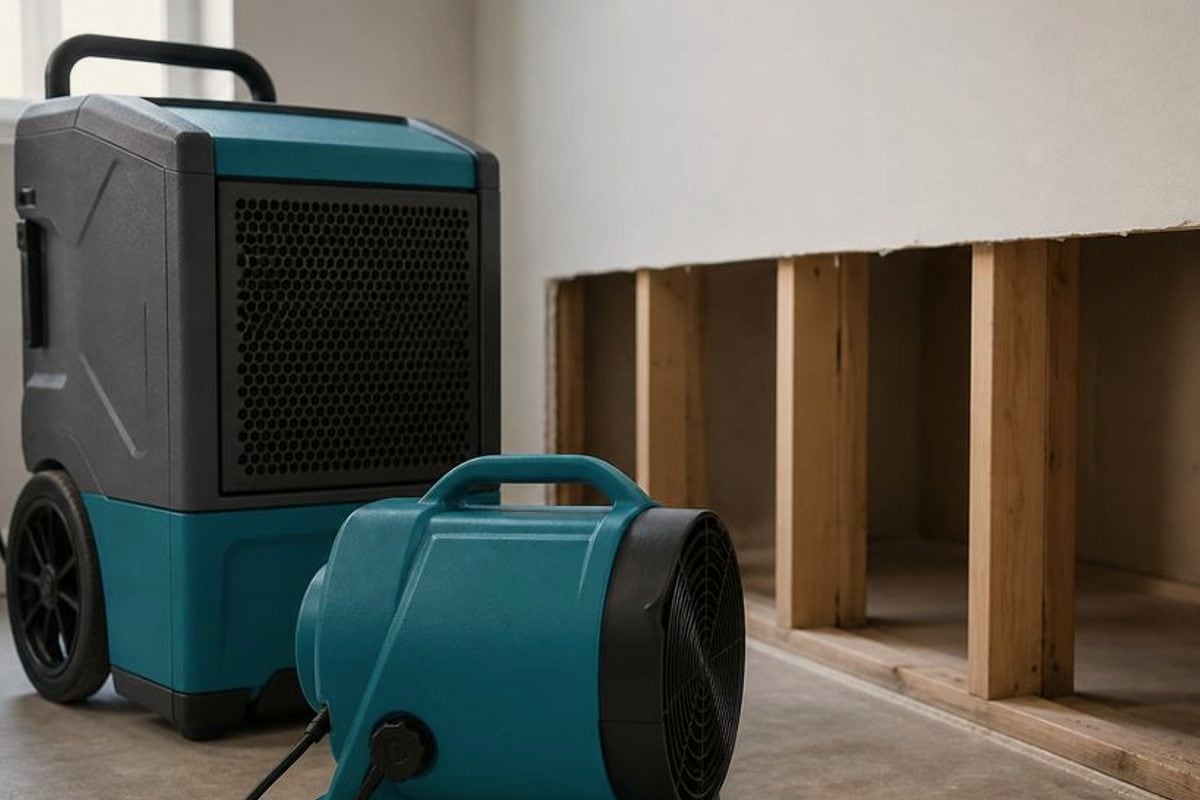
Air movers create controlled airflow across wet surfaces to speed up evaporation, while dehumidifiers remove that moisture from the air before it can resettle on other materials. Technicians place this equipment based on airflow patterns specific to the room, not just anywhere convenient, which is why professional drying setups look different from a homeowner pointing a box fan at a wet carpet.
The Science Behind Drying (Evaporation and Dehumidification)
Drying works by increasing the rate at which moisture evaporates from wet materials into the surrounding air, then removing that humid air before it can re-saturate the same materials. Relative humidity, temperature, and airflow all affect how fast this happens. Too much humidity in the air and materials can't release moisture efficiently, which is why dehumidification and air movement have to work together rather than relying on one alone.
IICRC Drying Classes (Class 1-4) Explained
The IICRC S500 standard categorizes water damage into four drying classes based on how much moisture was absorbed and how difficult the structure will be to dry.
| Class | Description |
|---|---|
| Class 1 | Least amount of water absorption, limited to part of a room with low-porosity materials |
| Class 2 | Larger amount of water absorption, affecting carpet and cushion or a larger area |
| Class 3 | Greatest amount of water absorption, often from water coming from overhead, affecting walls, insulation, and subfloor |
| Class 4 | Specialty drying situations involving materials with very low permeance, like hardwood, plaster, or concrete |
This classification directly affects how much equipment gets deployed and how long drying is expected to take. For more on how this connects to the broader restoration process, see Water Mitigation vs. Water Restoration: What's the Difference and Which Do You Need?.
Extraction and Drying as a Sequential Process
Extraction and drying aren't competing services or interchangeable options. They're two stages of one continuous process, and skipping the order or the sequence undermines both.
Why Extraction and Drying Can't Wait
Every hour that passes between a water loss and the start of extraction and drying gives moisture more time to spread into additional materials and increases the risk of mold growth. Mold needs moisture to develop, and delayed or incomplete drying is one of the most common reasons it takes hold after a water event. This isn't about manufactured urgency. It's the basic reality of how porous building materials and moisture interact. If you're weighing how quickly to act, How Long Does Water Damage Restoration Take? breaks down realistic timeframes for the full process.
How Drying Progress Is Measured and Verified
Drying progress is measured with moisture meters that compare readings in affected materials against an unaffected reference area, not by how a surface looks or feels. A room can appear completely dry to the eye while still holding excess moisture inside drywall or subfloor.
Moisture Mapping and Monitoring
Technicians document moisture readings throughout the drying process, sometimes supplementing with thermal imaging cameras to spot moisture patterns behind walls that aren't otherwise visible. These readings get logged over multiple days, and drying is only considered complete once materials reach a normal moisture level compared to the reference area, not on a fixed schedule.
Can You Handle Extraction or Drying Yourself?
You can handle extraction and drying yourself for very minor, clean-water spills, using a wet vacuum and household fans. Beyond that, consumer equipment usually can't generate the airflow or humidity control that professional-grade air movers and dehumidifiers provide, and hidden moisture behind walls or under flooring is easy to miss without a moisture meter. If you're unsure whether your situation qualifies as minor, a professional assessment is the safer starting point. What Happens During a Water Damage Inspection?
How Documentation Supports Your Insurance Claim
Most insurers expect documentation of the extraction and drying process, including photos, moisture readings, and drying logs, to support a water damage claim. This paperwork proves the loss happened, shows how it was addressed, and confirms materials reached a verified dry standard rather than just an assumed one. Requirements vary by policy and carrier, so it's worth confirming specifics with your insurance company early, ideally before cleanup starts rather than after.
Water Extraction and Structural Drying in Greater Los Angeles
Greater Los Angeles properties come with their own extraction and drying challenges, from older multi-unit buildings with limited crawlspace access to slab foundation homes where moisture gets trapped with nowhere obvious to go. LA Water Damage handles both extraction and structural drying as one coordinated process, using moisture mapping to confirm the job is actually finished, not just visually dry.
Our team is [details pending verification] and responds across Greater Los Angeles within [details pending verification]. Call request a callback or visit contact form if you're dealing with standing water or need drying verified.
Frequently Asked Questions About Water Extraction and Structural Drying
Is water extraction the same as structural drying?
No. Extraction removes standing and pooled water using pumps and vacuums. Structural drying is a separate, longer process that removes moisture absorbed into building materials like drywall, subfloor, and framing using air movers and dehumidifiers. Extraction typically happens first, drying follows.
Can I dry water damage myself with fans?
For very minor, clean-water spills, household fans may help with surface moisture. However, consumer fans and dehumidifiers usually can't reach the airflow and humidity control needed to fully dry materials, and hidden moisture behind walls or under flooring is easy to miss without professional moisture meters.
How long does structural drying usually take?
Drying time depends on the extent of the damage, the materials affected, and environmental conditions. It typically takes several days for the structure to reach a verified dry standard, though every situation is different. [details pending verification] for a specific estimate.
How do professionals know when a structure is fully dry?
Technicians use moisture meters and sometimes thermal imaging to check readings against dry industry benchmarks for each material type, and compare them to an unaffected reference area. Drying is confirmed complete only when readings return to normal, not by visual appearance alone.
Will mold grow if drying is delayed?
Delayed or incomplete drying increases the risk of mold growth, since mold needs moisture to develop. The exact timeline depends on humidity, temperature, and material type, which is why professional assessment and prompt drying are recommended.
What equipment is used for structural drying?
Common equipment includes air movers to increase evaporation, and low grain refrigerant (LGR) or desiccant dehumidifiers to remove moisture from the air. Equipment selection depends on the size of the space and the extent of the damage.
Does my insurance require documentation of the extraction and drying process?
Many insurers expect documentation such as photos, moisture readings, and drying logs to support a claim. Requirements vary by policy and carrier, so confirm specifics with your insurance company.
Extraction gets the water out. Drying is what actually protects your home from mold and long-term damage, and it's not something worth cutting short. If you need extraction, drying, or verification that a previous drying job was actually completed, call request a callback or visit contact form.
---