
Property Damage Restoration Glossary: Every Term Homeowners and Adjusters Actually Ask About
If you've just gotten off the phone with an insurance adjuster or a restoration company and you're not sure what half the words they used actually mean, you're not alone. Restoration language gets thrown around fast during a stressful moment, and most of it was never explained to you in plain English first.
This glossary exists to fix that. It covers the terms that actually come up during a water, fire, mold, or storm damage claim in Greater Los Angeles, defined the way a homeowner needs them defined, not the way an industry manual would.
How to Use This Glossary
Use this page as a reference, not a cover-to-cover read. Jump to the category that matches your situation, or use the A-Z list if you already know the specific term you heard. Every entry opens with a one-sentence plain definition before any extra detail, so you can get the answer fast and move on.
If you're mid-claim right now, start with the Insurance and Estimating Terms section and the Water Damage Terms section. Those two cover the words that show up most often in the first 48 hours.
Browse by Category
- Water Damage Terms
- Drying Science and Equipment Terms
- Mold and Air Quality Terms
- Fire and Smoke Terms
- Reconstruction and Structural Terms
- Insurance and Estimating Terms
- Standards and Certification Terms
Browse A-Z
Abatement, Absorption, Antimicrobial Pesticide, Board-Up and Tarping, Category 1/2/3 Water, Containment, Deductible, Dehumidification, Dew Point, Drying Log, HEPA Filter, IICRC, Mitigation, Mold Condition 1, Mold Remediation, Moisture Mapping, Negative Air Pressure, Pre-Loss Condition, Reconstruction, Scope of Work, Smoke Damage Restoration, Structural Drying, Xactimate.
Water Damage Terms
Water damage terminology splits into two systems that get confused constantly: how contaminated the water is, and how much of it there is. This section covers the contamination side. Water Category vs Water Class breaks down the full classification system in depth.
Water Mitigation
Water mitigation is the emergency response phase that stops water damage from getting worse. It includes extracting standing water, removing wet materials that can't be saved, and setting up equipment to begin drying before mold has a chance to start. Mitigation is almost always the first call made after a leak, burst pipe, or flood, and it's typically billed and scoped separately from the repair work that follows. Mitigation vs Remediation vs Restoration covers exactly where mitigation ends and the next phase begins.
Category 1 Water (Clean Water)
Category 1 water is water from a clean source, such as a supply line break or an overflowing sink, that poses no immediate health risk on contact. It's the least dangerous starting point for a water loss, but it doesn't stay that way automatically. Left standing too long, typically in the range of 48 to 72 hours, Category 1 water can degrade into Category 2 as bacteria and contaminants develop.
Category 2 Water (Gray Water)
Category 2 water, commonly called gray water, contains contamination significant enough to cause illness or discomfort if you're exposed to it. Common sources include washing machine overflow, dishwasher discharge, and toilet overflow without solid waste. It requires antimicrobial treatment and should not be handled casually, even though it's less hazardous than Category 3.
Category 3 Water (Black Water)
Category 3 water is grossly contaminated water that can carry pathogens, sewage, or toxins, commonly called black water. Sources include sewage backups, flooding from rivers or storm surge, and water that has picked up contamination from the ground. Category 3 water should always be treated as a health hazard, and porous materials it has touched are often removed rather than dried in place, since drying can't reliably eliminate the contamination inside them.
Mitigation vs. Restoration
Mitigation and restoration are frequently used as if they mean the same thing, and they don't. Mitigation is the emergency phase that stops the damage from spreading. Restoration is the rebuilding phase that comes after, returning the property to its condition before the loss occurred. See the comparison table below for the full breakdown of how these terms relate.
| Term | What It Means | When It Happens |
|---|---|---|
| Mitigation | Stopping further damage | Immediately after the loss |
| Restoration | Rebuilding to pre-loss condition | After the property is stable and dry |
Pre-Loss Condition
Pre-loss condition refers to the state your property was in immediately before the damage occurred, and it's the benchmark that restoration work is measured against. Insurance policies and scopes of work are typically written around returning a property to pre-loss condition, not upgrading it. If you want upgrades made during repair work, that's usually treated as a separate, out-of-pocket cost beyond what a claim covers.
Drying Science and Equipment Terms
Drying isn't guesswork, even though it can look like a random collection of fans and machines sitting in your living room. Every piece of equipment and every measurement serves a specific purpose in bringing your home's moisture content back to normal.
Structural Drying
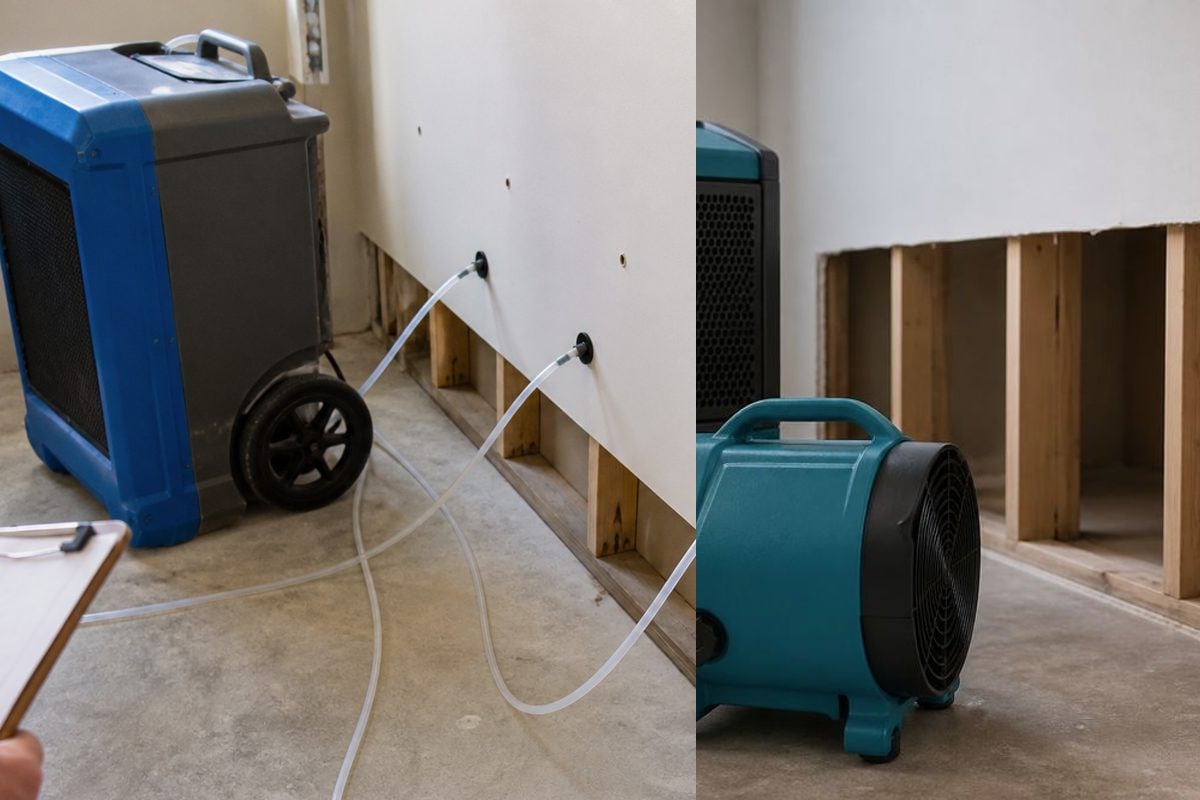
Structural drying is the controlled process of removing moisture from a building's framing, subfloors, drywall, and other structural materials after a water event. It typically combines air movers, dehumidifiers, and ongoing moisture monitoring to bring materials back down to a normal moisture range before mold or further damage can take hold. Dehumidifier vs Air Mover: Different Roles in Drying explains exactly how these two tools work together during this process.
Dehumidification
Dehumidification is the process of removing excess moisture from the air using a dehumidifier, which pulls humid air across a cold coil, condenses the moisture out, and releases drier air back into the room. It's the counterpart to air movement, and the two are typically run together rather than one instead of the other.
Moisture Mapping
Moisture mapping is the practice of measuring and recording moisture levels across affected materials using a moisture meter, then documenting how those readings change over the course of drying. It gives technicians (and your insurance file) an objective record that materials have actually returned to a normal, dry range, rather than just looking dry on the surface.
Absorption
Absorption describes how much water a material has taken in and how deeply, which varies enormously between materials. Carpet padding absorbs quickly and heavily. Concrete absorbs slowly but can hold moisture for a long time. Absorption rate is one of the main factors that determines how a material is classified under the water damage class system.
Dew Point
Dew point is the temperature at which air becomes saturated and releases its moisture as condensation. Restoration technicians monitor dew point alongside temperature and humidity because drying equipment performs differently depending on how close the air is to its dew point, and getting this wrong can actually slow drying down instead of speeding it up.
Drying Log
A drying log is the daily record of moisture readings, equipment placement, and environmental conditions kept throughout a drying project. It documents that the property was monitored properly and reached a dry standard before equipment was pulled, which matters both for your own peace of mind and for insurance documentation if a dispute comes up later.
HEPA Filter
A HEPA filter is a high-efficiency particulate air filter capable of capturing at least 99.97 percent of particles down to 0.3 microns in size, including mold spores, dust, and other fine contaminants. HEPA filtration is standard equipment on mold remediation and many fire and smoke cleanup jobs, since ordinary filters aren't fine enough to capture the particles involved.
Negative Air Pressure
Negative air pressure is a containment technique where equipment pulls air out of a work area faster than air enters it, keeping contaminants like mold spores from spreading into unaffected parts of the home. It's a standard safety practice on mold remediation jobs and is typically set up and monitored by a trained technician, not something a homeowner should attempt on their own.
Containment
Containment refers to physical barriers, usually plastic sheeting and negative air pressure, used to isolate a work area from the rest of the property during mold remediation, demolition, or contamination cleanup. Proper containment keeps dust, spores, and debris from spreading into rooms that weren't originally affected.
Mold and Air Quality Terms
Mold assessment and remediation involving suspected toxigenic species should be evaluated by a qualified professional before occupants re-enter affected areas. Mold terminology gets used loosely in casual conversation, but the industry does draw real distinctions worth knowing.
Mold Remediation
Mold remediation is the process of containing, removing, and treating mold-affected materials to bring indoor air quality and material conditions back to a normal, healthy range. It typically involves containment, HEPA air filtration, removal of unsalvageable porous materials, and antimicrobial treatment of surfaces that can be saved.
Mold Condition 1 (Normal Fungal Ecology)
Mold Condition 1 describes an indoor environment with a normal, expected level of fungal spores comparable to a typical outdoor environment, meaning no remediation is needed. This baseline term matters because it's what a post-remediation verification is actually measuring against, not "zero mold," which isn't a realistic or necessary standard.
Antimicrobial Pesticide
An antimicrobial pesticide is a product registered by the EPA to control mold, bacteria, and other microorganisms on surfaces during remediation work. These products are applied after physical mold removal, not as a substitute for it, since chemical treatment alone doesn't remove the underlying moisture problem or the physical mold material.
Fire and Smoke Terms
Fire damage restoration involves its own vocabulary layered on top of everything above, since most significant fires also involve water damage from suppression efforts.
Board-Up and Tarping
Board-up and tarping is the emergency service of covering broken windows, damaged doors, and compromised roof sections with plywood or tarps to secure a property and prevent further weather damage or unauthorized entry. It's typically one of the very first steps taken after a fire, storm, or break-in, often before any cleanup begins.
Smoke Damage Restoration
Smoke damage restoration is the process of removing soot, odor, and residue left behind after a fire, even in areas the flames never physically reached. Smoke particles travel through HVAC systems and settle into fabric, drywall, and porous surfaces throughout a property, which is why smoke damage often extends far beyond the visibly burned area.
Reconstruction and Structural Terms
Reconstruction
Reconstruction is the rebuilding phase that replaces structural components and finishes that were removed or destroyed during a loss, covering everything from framing and drywall to flooring and cabinetry. Cleanup vs Repair vs Reconstruction walks through exactly when a project crosses the line from repair into full reconstruction.
Abatement
Abatement is the removal or containment of any hazardous material, a category that includes mold, asbestos, and lead paint, not mold specifically. The term overlaps heavily with remediation in casual use, but abatement is technically the broader term covering multiple hazard types.
Insurance and Estimating Terms
Insurance vocabulary is where most homeowners feel the most lost, and money and coverage confusion deserve to be addressed directly rather than glossed over.
Scope of Work
A scope of work is the itemized list of tasks, materials, and labor a restoration company documents and submits, often to an insurance adjuster, describing exactly what will be done to return a property to pre-loss condition. It's the document that justifies pricing and coordinates the entire claim, so it's worth reading closely and asking questions about before work begins.
Deductible
A deductible is the amount of a covered loss you're responsible for paying out of pocket before your insurance policy starts covering the remainder. Deductibles vary by policy and sometimes by peril, meaning your water damage deductible and your wildfire deductible under the same policy could be different amounts.
Xactimate
Xactimate is the estimating software most insurance adjusters and restoration companies use to price repair and restoration line items based on regional labor and material costs. Because it's the industry-standard pricing tool on both sides of a claim, understanding that your restoration company's estimate was likely built in Xactimate can help explain why line-item pricing looks the way it does.
Standards and Certification Terms
Any structural, electrical, or mold-safety work should be performed or supervised by an appropriately certified or licensed professional. [details pending verification] for LA Water Damage's specific credentials.
IICRC
IICRC stands for the Institute of Inspection, Cleaning and Restoration Certification, the industry body that sets training standards for water, fire, and mold restoration technicians. A technician holding IICRC certification has completed standardized coursework in their discipline, and the IICRC S500 standard specifically governs water damage classification, which is why you'll see it referenced throughout this glossary.
One honest note worth adding here: even within the restoration industry, these terms don't always get used with perfect consistency. Different companies, and sometimes different adjusters, draw the lines between mitigation, remediation, and restoration slightly differently depending on training and regional habit. That's not a sign anyone is being dishonest with you. It's a reason to ask any company you're working with to define their terms in writing for your specific job rather than assuming everyone means exactly the same thing by the same word.
If you're on the phone with an adjuster right now and only have time to understand a handful of terms, prioritize these: water category, water class, mitigation, scope of work, deductible, and pre-loss condition. Those six will get you through most of the conversations that actually determine what happens to your claim.
Frequently Asked Questions About Restoration Terminology
What is the difference between mitigation and restoration?
Mitigation is the emergency phase that stops further damage, extracting standing water, drying materials, and preventing mold growth. Restoration is the rebuilding phase that returns the property to its pre-loss condition, including repairs, replacement of damaged materials, and finishing work. Mitigation happens first, restoration follows once the property is stable.
What does "Category 3 water" mean?
Category 3 water is grossly contaminated water, commonly called black water, that can contain pathogens, sewage, or toxins. Sources include sewage backups and floodwater. It requires strict safety protocols, protective equipment, and often removal of affected porous materials rather than drying them in place. Always treat suspected Category 3 water as a health hazard.
What is structural drying?
Structural drying is the controlled process of removing moisture from a building's structure, framing, subfloors, drywall, after a water event, typically using air movers, dehumidifiers, and moisture monitoring. The goal is to bring materials back to a normal moisture content before mold or further damage can develop.
What does IICRC certified mean?
IICRC stands for the Institute of Inspection, Cleaning and Restoration Certification, an industry body that sets training standards for water, fire, and mold restoration technicians. A technician holding IICRC certification has completed standardized coursework in the relevant discipline. [details pending verification] for LA Water Damage's specific credentials.
What is a scope of work in a restoration claim?
A scope of work is the itemized list of tasks, materials, and labor a restoration company documents and submits, often to an insurance adjuster, describing exactly what will be done to return a property to its pre-loss condition. It's used to justify pricing and coordinate the claim.
What's the difference between mold remediation and mold abatement?
The terms are often used interchangeably, but remediation typically refers to the full process of containment, air filtration, and removal of mold-affected materials, while abatement more broadly covers removing or containing any hazardous material, including mold, asbestos, or lead. Always confirm scope with your provider before work begins.
What is negative air pressure and why is it used in mold jobs?
Negative air pressure is a containment technique where equipment pulls air out of a work area faster than it enters, keeping mold spores and contaminants from spreading to unaffected rooms. It's a standard safety practice on mold remediation and some fire and smoke jobs. A qualified technician should set up and monitor this system.
Do I need a public adjuster or does the restoration company handle my insurance claim?
A restoration company documents damage and provides a scope of work and estimate, but a public adjuster works independently, on your behalf, to negotiate your claim's value with the insurer. Some homeowners use both, and it depends on claim complexity. [details pending verification].
Why Understanding These Terms Matters Before You Call Anyone in Greater Los Angeles
Los Angeles's housing stock adds its own wrinkle to all of this. A huge share of the city's homes were built before 1960, which means clay pipe, cast iron, and galvanized supply lines are still common, and LADWP has been open about the fact that roughly 30 percent of its water mains are over 80 years old. That older infrastructure means water losses here often involve source questions, and category questions, that newer construction elsewhere doesn't raise as often. Understanding category and class before your first call helps you ask sharper questions and catch it early if something in a scope of work doesn't add up.
What LA Water Damage Does at Each Stage
[details pending verification]
Get Help Now
If you're dealing with active water, fire, or mold damage in Greater Los Angeles and want a clear, plain-English assessment of what you're actually facing, call request a callback or visit contact form.
---