
Meta description: Learn what property damage restoration includes, what to do after water, flood, sewage, fire, smoke, or mold damage, and how to choose qualified help.
A pipe bursts behind a wall. A storm pushes water through the roof. A sewer line backs up into a finished basement. A kitchen fire is extinguished, but smoke residue reaches rooms far from the flames.
In the first few minutes, most property owners ask the same questions:
Is it safe to stay? What should I move? Who should I call? Will insurance cover the work? Can the damaged materials be saved?
Property damage restoration is the coordinated process of making a damaged building safe, limiting further loss, cleaning and drying affected areas, and repairing the property when necessary.
The exact scope depends on the cause of the loss, the affected materials, contamination, exposure time, and the condition of hidden spaces.
The most important rule is simple: protect people before property.
Leave the building and contact emergency services when there is an active fire, suspected structural instability, a gas odor, live electrical danger, fast-moving water, sewage exposure, or an evacuation order.
Do not re-enter a damaged structure until the appropriate authority says it is safe.
This guide explains the major types of restoration, the typical project stages, cost and insurance factors, and the evidence you should expect from a restoration provider.
What Should You Do Immediately After Property Damage?
Start with life safety. Then prevent additional damage only when it is safe to do so.
1. Leave when there is a serious hazard. Do not remain in a building with fire risk, shifting structural elements, suspected gas leaks, exposed wiring, contaminated water, or official evacuation instructions.
2. Contact emergency authorities when needed. Fire departments, utility providers, building officials, and emergency agencies may need to control the scene before restoration begins.
3. Avoid contaminated water. Floodwater can contain sewage, chemicals, debris, microorganisms, downed power lines, and other hazards. CDC guidance recommends staying out of floodwater whenever possible.
4. Document the damage when safe. Take wide photographs and close-up images or videos. Record affected rooms, damaged materials, belongings, visible water lines, and temporary repairs. The National Association of Insurance Commissioners recommends documenting losses and contacting the insurer promptly.
5. Stop the source only when you can do so safely. This might mean using an accessible water shutoff. Never enter standing water to reach an electrical panel or operate damaged equipment.
6. Contact a qualified restoration provider. Share the loss type, when it happened, affected areas, known hazards, utility status, access restrictions, and any photographs you can safely take.
A rushed cleanup can spread contamination, erase useful claim evidence, or create new safety risks.
Stabilization should be fast. It should not be careless.
What Is the Difference Between Mitigation and Restoration?
Mitigation is the immediate work used to limit additional property damage. Restoration is the broader process used to clean, dry, repair, or rebuild the property.
Emergency mitigation may include temporary protection, water extraction, containment, debris control, moisture assessment, or moving vulnerable contents away from an affected area.
These actions are intended to prevent the loss from becoming larger.
Restoration begins with a defined scope of work. Depending on the loss, it may include:
- Controlled structural drying
- Material cleaning
- Decontamination
- Odor treatment
- Selective demolition
- Contents handling
- Repairs
- Reconstruction
Some projects are almost entirely mitigation. Others continue into extensive repairs or reconstruction.
The distinction matters because each phase can involve different contractors, technical decisions, documentation, and insurance review.
Ask for a written scope explaining what is included, what is excluded, which materials will be monitored, and what conditions could change the plan.
How Does Water Damage Restoration Work?
Water damage restoration focuses on finding the source, removing excess water, identifying affected materials, and drying the building to verifiable conditions.
A reliable assessment does more than inspect the visible puddle.
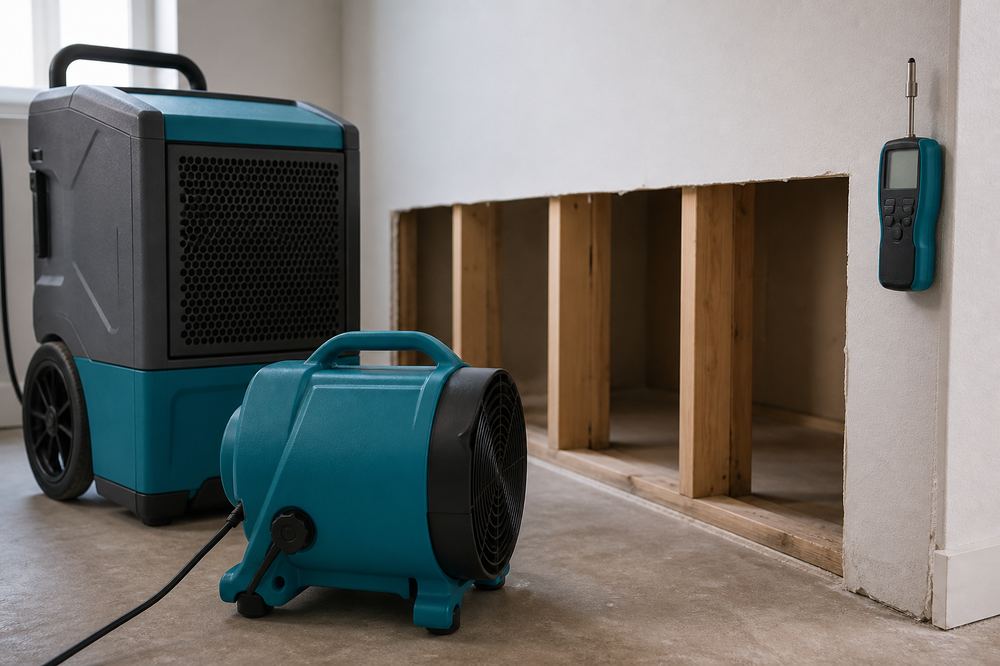
Water can move under flooring, into wall cavities, through insulation, and across adjoining rooms. Moisture mapping helps identify the boundaries of the loss. Readings taken throughout the project can show whether materials are drying or whether hidden moisture remains.
Typical water damage restoration work may include:
- Source and safety assessment
- Standing-water extraction
- Moisture mapping
- Material evaluation
- Air movement and dehumidification
- Controlled material removal
- Cleaning appropriate to the water source
- Repeat moisture measurements
- Drying logs
- Repairs after completion criteria are met
Drying time cannot be promised from a photograph or telephone call.
It depends on the water source, exposure time, building materials, temperature, humidity, airflow, access to hidden areas, and whether moisture continues entering the building.
What Is Structural Drying?
Structural drying is the controlled removal of moisture from building materials and assemblies.
It commonly involves a combination of extraction, airflow, dehumidification, temperature control, material access, and repeated measurements.
Air movers encourage moisture to evaporate from wet surfaces. Dehumidifiers remove moisture from the surrounding air. Moisture meters and environmental readings help the restoration team evaluate progress.
Equipment alone does not prove that a property is dry.
The provider should be able to explain:
- Which materials are being monitored
- Where readings are being taken
- What drying goals are being used
- How equipment placement was determined
- When readings will be repeated
- What happens when a material does not respond as expected
Can Wet Drywall, Flooring, or Cabinets Be Saved?
Sometimes.
Salvage decisions should be material-specific rather than based on a universal rule.
Drywall may remain serviceable after a limited clean-water event when it is structurally intact, uncontaminated, accessible for drying, and verified dry.
It is less likely to be retained when it is swollen, crumbling, contaminated, delaminated, or trapping moisture inside a wall cavity.
Wood flooring can sometimes be dried. However, cupping, finish condition, subfloor moisture, wood species, installation method, and exposure time all affect the decision.
Laminate and some engineered flooring products may deteriorate quickly after water reaches their inner layers.
Cabinets may be repairable when their solid components remain stable. Particleboard boxes, shelves, and toe kicks often react differently.
The correct answer is rarely “keep everything” or “remove everything.”
It should be a documented decision based on material condition, contamination, access, and drying performance.
How Is Flood Damage Different From a Plumbing Leak?
Outdoor floodwater should be treated as potentially contaminated because its contents are unknown.
Floodwater may carry human or animal waste, chemicals, microorganisms, sharp debris, and electrical hazards.
That changes the restoration plan.
A flood project may require stronger exposure controls, more selective material removal, specialized cleaning, and additional documentation.
Electrical systems, appliances, HVAC components, private wells, and building materials may also need separate professional evaluation.
Do not assume every item touched by floodwater must be discarded. However, do not assume that everything can be cleaned safely.
The decision depends on:
- Material porosity
- Type of contamination
- Length of exposure
- Physical deterioration
- Access to hidden surfaces
- Available cleaning methods
- Applicable regulations or health guidance
Flood insurance can also be different from standard homeowners insurance.
Coverage depends on the policy and the cause of loss. The insurer, not the restoration contractor, makes the coverage decision.
Discuss the event with your insurance representative rather than relying on a contractor’s prediction.
Why Does Sewage Cleanup Require Specialized Controls?
A sewage backup can expose people and building materials to pathogens and spread contamination into porous materials, floor assemblies, wall cavities, and adjoining surfaces.
The first priority is isolation.
Keep occupants, children, pets, and unprotected workers away from the affected area. Avoid walking through the loss and carrying contamination into clean rooms.
Professional sewage cleanup may involve:
- Work-area containment
- Controlled material removal
- Personal protective equipment
- Cleaning
- Decontamination
- Odor-source removal
- Structural drying
- Documentation
- Defined completion checks
The exact procedure depends on the source, affected materials, exposure path, building use, and local requirements.
Do not mix cleaning chemicals or use ordinary household fans that could spread contaminants.
Do not rely on fragrance to judge whether an area is clean.
Odor reduction is not the same as decontamination. A surface that looks clean may not represent the full extent of the loss.
What Happens During Fire and Smoke Damage Restoration?
Fire restoration begins after emergency officials release the property for safe access.
The damage may include burned materials, smoke and soot deposits, water from firefighting, damaged contents, broken openings, and compromised utilities.
The U.S. Fire Administration advises residents to focus on safety, insurance, property valuation, document replacement, and salvage during the first stage of recovery.
A restoration team may evaluate:
- Structural and access hazards
- Temporary roof, door, or window protection
- Water damage caused by firefighting
- The type and distribution of smoke residue
- Appropriate cleaning methods for each surface
- Odor sources inside materials and cavities
- Contents requiring specialist evaluation
- Areas that need repair or reconstruction
Smoke is not one uniform substance.
Residue behaves differently depending on what burned, how hot the fire became, how air moved through the building, and which surfaces were exposed.
An aggressive cleaning method can permanently damage a finish or drive residue farther into porous material.
After wildfire exposure, ash may irritate the eyes, skin, and respiratory system. EPA and CDC guidance recommends limiting exposure, wearing appropriate protective equipment, and avoiding cleanup methods that unnecessarily send ash back into the air.
No responsible provider should guarantee that every belonging can be saved or every odor eliminated before inspection and testing.
Can Smoke-Damaged Belongings Be Restored?
Some belongings can be restored. Others cannot.
The decision depends on:
- The material
- Heat exposure
- Residue type
- Contamination
- Physical damage
- Monetary or sentimental value
- Available cleaning methods
- The cost of restoration compared with replacement
Textiles, electronics, documents, artwork, photographs, furniture, and porous belongings may require specialist evaluation.
Ask how each category will be inventoried, packed, transported, cleaned, tested, stored, and returned.
A contents proposal should also explain what happens when an item fails cleaning or testing.
When Does Water Damage Become a Mold Problem?
Mold risk increases when moisture remains in susceptible building materials.
EPA identifies moisture control as the central strategy for preventing indoor mold and advises drying water-damaged areas and items within 24 to 48 hours when possible.
That timeframe is a reason to act promptly. It is not a guarantee that mold will appear at an exact hour.
Temperature, humidity, material type, ventilation, contamination, and previous conditions all affect growth.
Mold-related work can involve several different services.
Mold Inspection
An inspection evaluates visible conditions, moisture sources, affected materials, and whether further investigation may be needed.
Mold Testing
Testing involves collecting samples to answer a defined question when sampling is appropriate.
Testing is not automatically required for every visible mold condition.
Mold Remediation
Remediation is controlled work intended to address affected materials and moisture-related conditions.
It may include containment, controlled removal, cleaning, and correction of the underlying moisture problem.
Post-Remediation Verification
Post-remediation verification evaluates whether the defined work area meets agreed completion criteria.
It may involve visual inspection, moisture assessment, and sampling when appropriate to a documented protocol.
Inspection, testing, remediation, and verification are not interchangeable terms.
Remediation is also unlikely to succeed over the long term when the moisture source remains unresolved.
What Does Commercial Property Restoration Require?
Commercial restoration uses the same safety and technical foundations as residential restoration, but the operational stakes are different.
Property managers, facility teams, and business owners may need to protect occupants, isolate affected areas, maintain essential operations, coordinate multiple decision-makers, and preserve extensive documentation.
A technically sound cleanup can still fail operationally when communication breaks down.
A commercial restoration plan should identify:
- The emergency contact and approval chain
- Critical areas that must remain accessible
- Occupant or tenant communication responsibilities
- Security and access restrictions
- Permitted work hours
- Documentation and reporting expectations
- Equipment, noise, dust, and containment constraints
- The procedure for approving scope changes
- The handoff from mitigation to repair
For complex facilities, ask the provider how it will coordinate with property management, consultants, insurers, subcontractors, and local authorities.
Claims of commercial experience should be supported by relevant project evidence rather than a generic client-logo list.
What Are the Main Stages of Property Damage Restoration?
Although every loss is different, most restoration projects follow a recognizable sequence.
1. Safety and Site Access
The team identifies immediate hazards, confirms authorized access, and determines whether emergency authorities or specialists must act first.
2. Assessment and Documentation
The affected areas, materials, source, visible damage, moisture conditions, contamination concerns, and access limitations are documented.
This information becomes the basis for the initial scope of work.
3. Emergency Mitigation
The team takes approved steps to limit further damage.
Work might include water extraction, temporary protection, containment, debris control, or relocating vulnerable contents.
4. Cleaning, Drying, or Decontamination
The method depends on the loss type.
Water losses may require extraction, drying, and monitoring. Sewage losses may require controlled material removal and decontamination. Fire losses may require residue removal, odor-source treatment, and contents handling.
5. Monitoring and Scope Adjustment
Measurements, observations, and material response are reviewed.
Hidden damage or changing conditions may require a revised scope. Changes should be documented and approved in writing.
6. Completion Review
The provider should explain the completion criteria used for its work.
Depending on the project, documentation may include:
- Visual inspection
- Moisture data
- Environmental readings
- Cleaning records
- Photographs
- Material inventories
- Third-party verification
7. Repair or Reconstruction
Damaged materials are repaired or replaced after mitigation and cleanup.
Reconstruction may be performed by the restoration company or a separate contractor, depending on licensing, project scope, and the provider’s verified services.
How Much Does Property Damage Restoration Cost?
There is no reliable flat price for property damage restoration because the visible damage is only one cost factor.
The estimate may be affected by:
- Loss type and contamination
- Number of affected rooms
- Total affected area
- Building materials and assemblies
- Access to wall, floor, or ceiling cavities
- Containment requirements
- Extraction, drying, cleaning, or specialty equipment
- Labor and supervision
- Demolition and disposal
- Contents handling and storage
- Permit or code requirements
- Emergency access constraints
- Repair and reconstruction requirements
Ask for an itemized written scope.
It should distinguish emergency work, material removal, cleaning, drying, equipment, monitoring, contents services, and repairs.
It should also explain assumptions and exclusions.
A low initial number is not useful when it excludes necessary work. A high number is not automatically evidence of a complete scope.
Compare what each proposal includes, the evidence behind its quantities, and how changes will be authorized.
How Do Insurance and Restoration Work Together?
The restoration provider documents the damage and proposes work. The insurer interprets the policy and decides coverage.
Those roles should remain clear.
A contractor may provide:
- Photographs
- Measurements
- Estimates
- Drying records
- Material inventories
- Invoices
- Explanations of completed work
It should not guarantee claim approval or state that a loss is covered without the insurer’s determination.
NAIC consumer guidance recommends notifying the insurance company promptly, documenting the damage, keeping records, and understanding the deductible and claim process.
Maintain a project file containing:
- Photographs and videos
- A room-by-room damaged-item list
- Initial and revised scopes
- Estimates and invoices
- Moisture or drying records
- Temporary-repair receipts
- Emails and telephone notes
- Insurer correspondence
- Change orders
- Completion documents
Do not discard damaged property before documentation and insurer guidance when retaining it is safe and practical.
However, do not delay urgent safety work merely to preserve evidence.
What Are Replacement Cost and Actual Cash Value?
These terms describe different approaches to valuing insured property.
Replacement cost coverage generally considers the cost of repairing or replacing damaged property with materials of comparable kind and quality, subject to the policy’s terms.
Actual cash value generally considers depreciation, including factors such as age and wear.
The precise calculation, payment process, limits, and conditions depend on the individual policy. NAIC guidance explains that these coverage types can produce different out-of-pocket outcomes.
A restoration contractor may prepare repair estimates. It does not control how the insurer applies policy valuation provisions.
How Should You Choose a Property Restoration Company?
Choose a provider that can explain its decisions and support its claims with evidence.
Ask the following questions.
What Services Do You Perform Directly?
Clarify which work is performed by employees, which work is subcontracted, and who is responsible for each project phase.
Which Credentials Apply to This Work?
Ask about relevant licenses, certifications, insurance, and training.
Verify important credentials independently. A logo on a website is not sufficient proof.
How Will You Document the Damage?
Expect clear photographs, measurements, moisture readings, inventories, and written assumptions when they are relevant to the loss.
How Do You Decide What Can Be Saved?
The explanation should consider contamination, physical condition, material type, access, cleaning options, and verifiable drying performance.
How Are Scope Changes Approved?
Avoid open-ended authorization.
The agreement should explain how hidden damage, additional work, price changes, and schedule changes will be communicated and approved.
What Are the Completion Criteria?
“Looks dry” or “smells better” is not enough for technical drying, decontamination, or controlled remediation.
Ask what evidence will show that the defined work is complete.
Can You Provide Relevant Case Studies?
Useful case studies include:
- Property type
- Cause of loss
- Affected materials
- Initial conditions
- Project scope
- Constraints
- Measurements
- Photographs
- Timeline
- Documented outcome
The example should resemble your situation closely enough to be meaningful.
How Will You Communicate During the Project?
Ask who will provide updates, how frequently reports will be issued, and who can approve important decisions.
What Is Excluded?
Exclusions can matter as much as the advertised service.
A clear proposal should explain services, materials, repairs, testing, permits, moving, storage, and specialist work that are not included.
What Happens After I Authorize the Work?
The provider should explain the intake process, site assessment, documentation, initial stabilization, estimate development, and next decision point.
It should do this without making unsupported promises about arrival time, pricing, coverage, or project duration.
Warning Signs to Watch For
Be cautious when a company:
- Guarantees insurance approval
- Refuses to provide a written scope
- Uses unexplained pressure to sign immediately
- Cannot identify who will perform the work
- Avoids questions about credentials or insurance
- Promises every damaged material can be restored
- Provides a fixed drying time before assessment
- Uses fragrance as proof that contamination is gone
- Cannot explain how completion will be verified
- Claims to be the fastest, best, or cheapest without evidence
- Requests major changes without written authorization
- Displays reviews, locations, or certifications that cannot be verified
Urgency is normal after property damage. Manipulation is not.
Frequently Asked Questions
Can I Stay in a Damaged Property During Restoration?
It depends on the hazards and the instructions of emergency officials and qualified professionals.
Leave when there is fire risk, structural instability, electrical danger, sewage contamination, significant smoke, or an evacuation order.
CDC guidance advises staying away from damaged structures until they have been examined and considered safe.
Should I Call My Insurance Company or a Restoration Company First?
Address immediate life-safety issues first.
Then contact both promptly. A restoration provider can help stabilize the property, while the insurer determines coverage and claim requirements.
Document the damage before cleanup when it is safe.
What Information Should I Give a Restoration Company?
Provide the loss type, when it happened, the known or suspected source, affected rooms and materials, visible hazards, utility status, and access constraints.
Include photographs only when you can take them safely.
Share claim details when available, but do not delay emergency safety actions while gathering paperwork.
Can Water Damage Cause Mold?
Persistent moisture creates conditions that support mold growth.
Prompt source control, water removal, and verified drying reduce the risk. EPA recommends drying wet materials within 24 to 48 hours when possible.
Is Floodwater Contaminated?
Treat outdoor floodwater as potentially contaminated.
Its contents may include sewage, chemicals, microorganisms, and debris that cannot be identified by appearance alone. Avoid contact and follow local authority and professional guidance.
Can Wet Drywall Be Saved?
Sometimes.
The decision depends on the water source, contamination, saturation, exposure time, physical damage, and whether the wall cavity can be dried and verified.
Drywall that is contaminated, swollen, crumbling, or unable to dry reliably is more likely to require removal.
Can Smoke-Damaged Belongings Be Restored?
Some can.
The decision depends on the material, heat exposure, residue type, contamination, value, and available cleaning methods.
Textiles, electronics, documents, artwork, and porous belongings may require specialist evaluation.
What Are Moisture Readings and Drying Logs?
Moisture readings measure conditions inside affected materials or the surrounding air.
Drying logs record readings, environmental conditions, equipment placement, and progress over time.
They support technical decisions and project documentation. They do not determine insurance coverage.
What Is Post-Remediation Verification?
Post-remediation verification is an evaluation conducted after mold remediation.
Its purpose is to determine whether the defined work area meets agreed completion criteria.
It may include visual inspection, moisture assessment, and sampling when appropriate to a documented protocol. It is not a guarantee that mold will never return.
Does Homeowners Insurance Cover Every Type of Water Damage?
No universal answer applies.
Coverage depends on the cause, timing, exclusions, endorsements, limits, and insurer review.
Ask the insurer or a licensed insurance representative to explain the relevant policy language.
What Should I Expect After Contacting a Restoration Company?
Expect questions about the loss, safety conditions, location, affected areas, access, utilities, and timing.
A responsible company should explain the next step, what can be assessed remotely, what requires a site visit, and which statements cannot be confirmed before inspection.
Better Restoration Decisions Begin With Better Evidence
Property damage creates pressure to act quickly. Speed should not replace judgment.
Begin with safety. Document what happened. Control the source when it is safe. Ask for a written scope. Keep the roles of the restoration contractor and insurer separate.
Choose a provider that uses clear evidence, explains its tradeoffs, and avoids guarantees it cannot support.
The strongest restoration projects are not built on dramatic promises.
They are built on disciplined assessment, careful mitigation, transparent documentation, and verifiable completion criteria.
Call to action: Contact [Brand] through [verified phone number or contact form] to discuss the loss type, affected area, and immediate safety concerns.
Replace these placeholders only after confirming the company’s actual services, availability, service area, credentials, and intake process.